

-Experience of Registrar who has passed the exam
FRCR oncology
ABOUT
Cellular Biology
-
What cancer is, growth disorders, dysplasia, carcinoma in situ and invasive disease.
-
Cell-cycle phases, checkpoints, cyclins/CDKs, RB, p53 and abnormal growth signalling.
-
DNA damage, repair pathways, mutations, oncogenes, tumour suppressor genes and inherited cancer syndromes.
-
Apoptosis, autophagy, cancer stem cells and mechanisms of treatment resistance.
-
Metastasis, angiogenesis, hypoxia, tumour vasculature and microenvironment.
-
Immune escape, checkpoint pathways and key targeted treatments linked to cancer biology.
Cellular Biology for FRCR Part 1:
master the core mechanisms of cancer cell growth, cell-cycle control, DNA repair, apoptosis, metastasis and treatment targets with clear, exam-focused understanding…
ABOUT
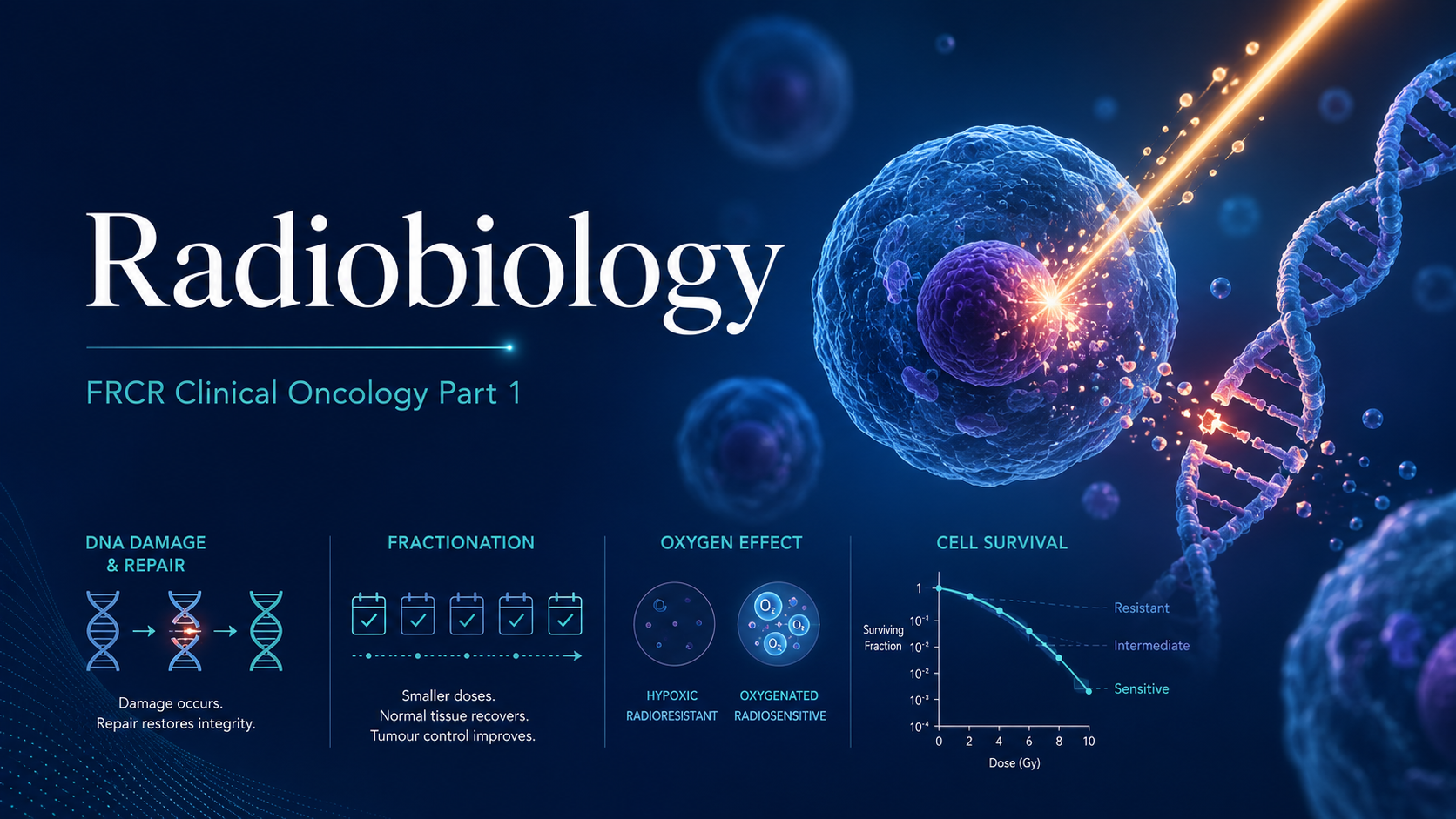
Radiobiology
-
DNA damage, lethal/sublethal damage, chromosome injury, direct and indirect radiation effects.
-
Survival fraction, SF2, alpha beta model, radiosensitivity and interpretation of survival curves.
-
Linear energy transfer, relative biological effectiveness, oxygen enhancement ratio and hypoxia.
-
Repair, repopulation, redistribution, reoxygenation, BED, EQD2 and fractionation schedules.
-
Tumour control, radiosensitivity, cell-cycle effects, hypoxia and interaction with systemic therapies.
-
Early and late effects, serial and parallel organs, tissue tolerance and retreatment principles.
Radiobiology for FRCR Part 1:
Master how radiation affects cells, tumours and normal tissues through DNA damage and repair, cell survival, LET, RBE, oxygen effect, fractionation, BED/EQD2 and tissue tolerance with clear, exam-focused understanding.
ABOUT
Physics
-
Atomic structure, electromagnetic radiation, X-ray/gamma production, attenuation and HVL.
-
Photoelectric effect, Compton scatter, pair production, secondary electrons, LET and charged particle interactions.
-
Absorbed dose, KERMA, exposure, ion chambers, TLDs, phantoms, calibration and dose measurement.
-
Beam energy, depth dose, build-up, skin sparing, field size, penumbra, wedges, shielding and electron dose distributions.
-
GTV, CTV, PTV, ITV, OAR, PRV, isodose curves, FSD/isocentric planning, DVH, DRR, IMRT and VMAT.
-
Linac principles, beam production, collimation, MLCs, isocentre, motion management, SABR delivery and plan appraisal.
-
Output, flatness, symmetry, energy, field size, IGRT checks, in vivo dosimetry, error reporting and plan verification.
-
Half-life, activity, inverse square law, source strength, afterloading, sealed/unsealed sources and prostate/gynae brachytherapy.
-
Time, distance, shielding, dose equivalent, staff monitoring, controlled areas, IR(ME)R, ARSAC and room design.
Physics for FRCR Part 1:
Master the core principles of radiotherapy physics, including radiation production, interactions with matter, dosimetry, treatment beams, planning, QA, brachytherapy and radiation protection with clear, exam-focused understanding.

ABOUT
Pharmacology
-
Core mechanisms of chemotherapy drugs, drug classes, cell-cycle effects and mechanisms of resistance.
-
Dose-limiting, acute, long-term, dose-related and idiosyncratic toxicities, including extravasation principles..
-
AUC, half-life, clearance, metabolism, activation, plasma concentration, tissue binding and target-site exposure.
-
Dose-response, dose intensity, single-agent versus combination therapy, high-dose therapy and multimodality interactions.
-
Anti-emetics, steroids, growth factors, anticoagulants and supportive drugs used alongside cancer treatment.
-
Analgesic ladder, opioids, co-analgesics, formulations, drug combinations and pain-control principles.
-
Important interactions between cancer drugs, supportive medicines and commonly used non-cancer medications.
-
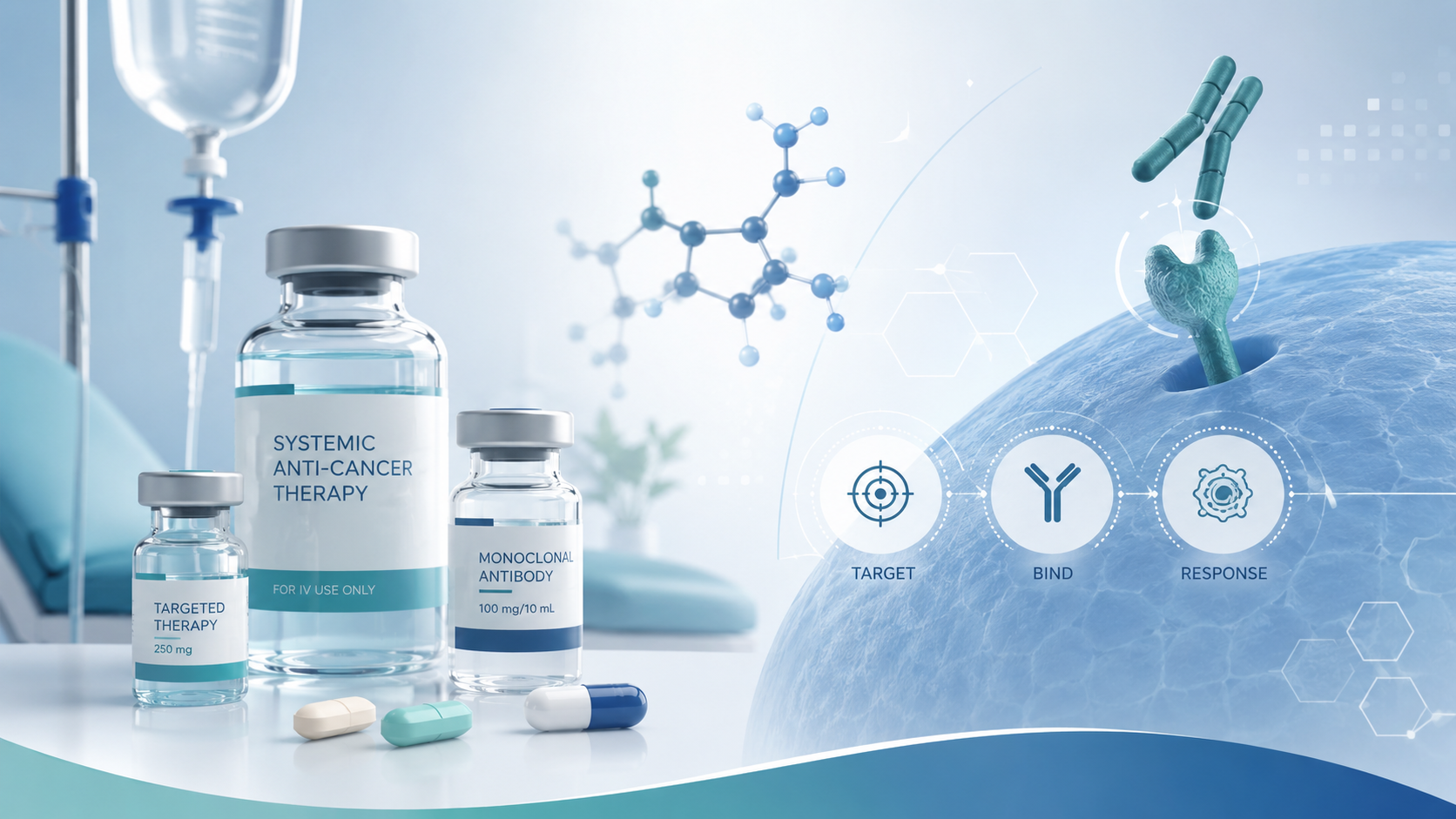
Molecular targeted therapies, signalling pathways, mechanisms of action and toxicity rationale.
Pharmacology for FRCR Part 1:
Master the core principles of systemic anti-cancer therapy, including cytotoxic drug mechanisms, targeted agents, pharmacokinetics, toxicity, dose modification, supportive medicines, analgesics and drug interactions with clear, exam-focused understanding.
ABOUT
Statistics
-
Data types, distributions, averages, spread, bar charts and histograms.
-
Source population, random sampling, standard error, confidence intervals and reference ranges.
-
P-values, Type I/II errors, statistical versus clinical significance and multiple testing.
-
Tests for means, proportions and choosing the right statistical test.
-
Scatter plots, correlation, regression and interpreting associations between variables.
-
Sensitivity, specificity, PPV, NPV, accuracy and how disease prevalence changes interpretation.
-
Kaplan-Meier curves, censoring, log-rank test, Cox regression and hazard ratios.
-
Trial phases, randomisation, blinding, trial designs, sample size, interim analysis and intention-to-treat.
-
Cohort, case-control and cross-sectional studies, odds ratios, risk ratios, incidence and prevalence.
Statistics for FRCR Part 1:
Master the core principles of medical statistics, including data types, sampling, confidence intervals, p-values, statistical tests, screening tests, survival analysis, clinical trial design and epidemiology with clear, exam-focused understanding.
